Friday, May 27, 2016

Ghandruk


Ghandruk


Ghandruk is a town and Village Development Committee in Kaski District in the Gandaki Zone of northern-central Nepal. At the time of the 1991 Nepal census it had a population of 4,748 persons living in 1,013 individual households.

Ghandruk is a popular place for treks in the Annapurna range of Nepal( i.e. specially for Annapurna Base camp trek), with easy trails and various accommodation possibilities.From Ghandruk there are views to the mountains of Annapurna including Machapuchare.

Ghandruk Trek is popular trekking trail in the Annapurna region. Ghandruk trek takes you to the naturally embodied village of Ghandruk in western Nepal. Ghandruk is a beautiful village with Gurung settlement. We can see the old Gurung museum in Ghandruk. Ghandruk offers a great view of Annapurna south, Gangapurna, Annapurna -III, Hiunchuli and Machhapuchhre. Ghandruk trek is ideal for all kind of trekkers as it offers an easy trekking trail with no difficult climbing or ascents to the high altitude. Ghandruk Trek further entices you with rich Gurung culture and tradition of people living in this exotic place.
 

This short trek provides a good introduction into trekking whilst also providing some wonderful close up views of both the sacred mountain Macchapuchre (Fishtail) and Annapurna South. Our destination is the beautiful and ornate village of Ghandruk, home to the Annapurna Conservation Area Project. Here you ha ve a chance to visit the project to discover at first hand the conservation work being carried out. A refreshing three days allowing an insight into mountain life. Maximum altitude 2600 m.

Manang


Manang village. Annapurna-III (left, 7555 m) and Gangapurna (7455 m) peaks are in the background.


It is situated in the broad valley of the Marshyangdi River to the north of the Annapurna mountain range. The river flows to the east. To the west, the 5,416-metre (17,769 ft) Thorong La pass leads to Muktinath shrine and the valley of the Gandaki River. To the north there is the Chulu East peak of 6,584 m (21,601 ft). Most groups trekking around the Annapurna range will take resting days in Manang to acclimatize to the high altitude, before taking on Thorong La pass. The village is situated on the northern slope[citation needed], which gets the most sunlight and the least snow cover in the winter. The cultivation fields are on the north slope[citation needed] with terraces.


Manang (Nepali: मनाङ) is a town in the Manang District of Nepal. It is located at 28°40'0N 84°1'0E with an altitude of 3,519 metres (11,545 ft). According to the preliminary result of the 2011 Nepal census it has a population of 6,527 people living in 1,495 individual households. Its population density is 3 persons/km2.


There are now motorable road as well as trails where goods are transported on jeep or mule trains or carried by porters. A small airport, located 2.5 km (1.6 mi) east of the town, serves the whole valley. The airport was began in 1985. The development of a trail linking Manang to the Annapurna Conservation Area was finished in February 2011 and has brought many benefits to the villagers and the area.

Besides catering to trekkers, there is some agriculture and herding of yaks. There is a medical centre, which specializes in high-altitude sickness.

Gosaikunda Lake


Gosaikunda (गोसाइकुन्ड), also spelled Gosainkunda and Gosain Kunda is an alpine freshwater oligotrophic lake in Nepal's Langtang National Park, located at an altitude of 4,380 m (14,370 ft) in the Rasuwa District with a surface of 13.8 ha (34 acres). Together with associated lakes, the Gosaikunda Lake complex is 1,030 ha (4.0 sq mi) in size and has been designated a Ramsar site on 29 September 2007.

The lake melts and sips down to form the Trishuli River and remains frozen for six months in winter October to June. There are 108 lakes in this area, small to medium in size. The challenging Lauribina La pass at an altitude of 4,610 m (15,120 ft) is on its outskirts.

Gosaikunda is a significant place of interest on the Dhunche-Helambu trekking route. This trek adjoins the famous Langtang Valley trek in the same district. Both treks can be combined. Basic accommodation is quite easily available. Tea houses offer a variety of food and snacks.


The trek to Gosaikunda starts in Dhunche Village or Syabru Besi in the Langtang Himal, or in Sundarijal in the Kathmandu Valley. When starting from Dhunche, the first day involves a long steady climb to reach Chandan Bari at an altitude of about 3,200 m (10,500 ft). Laurebinayak at about 3,700 m (12,100 ft) can be reached on the second day. At this point, some trekkers choose to climb ahead to Gosaikunda, though altitude sickness is a concern as the ascent is rather steep. Many trekkers choose to stay at Laurebinayak, which also provides sunset and sunrise views of the Langtang and Ganesh Himal. The descent from Gosaikund to Sundarijal (सुन्दरीजल) takes about four days and involves a short climb to Laurebina La at 4,610 m (15,120 ft), a rapid descent to Phedi and onwards to Ghopte. Depending on pace, there are options to stay at Thadepati, Mangengoth, Kutumsang and at many villages farther downhill. The trails are well marked, except between Ghopte and Thadepati.

Annapurna base camp trek


The Annapurna Conservation Area (7,629 km²) is a well known trekking region. There are three major trekking routes in the Annapurna region: the Jomsom Trek to Jomsom and Muktinath (increasingly disturbed by a road-building project[21]); the Annapurna Sanctuary route to Annapurna base camp; and the Annapurna Circuit, which circles the Annapurna Himal itself and includes the Jomsom route. The town of Pokhara usually serves as a starting point for these treks, and is also a good starting place for other short treks of one to four days, such as routes to Ghorepani or Ghandruk.

The Mustang district, a former kingdom bordering Tibet, is also geographically a part of the Annapurna region, but treks to upper Mustang are subject to special restrictions.

About two-thirds of all trekkers in Nepal visit the Annapurna region. The area is easily accessible, guest houses in the hills are plentiful, and treks here offer incredibly diverse scenery, with both high mountains and lowland villages. Also, because the entire area is inhabited, trekking in the region offers unique cultural exposure and experience.


Annapurna base camp trek, Annapurna sanctuary trekking, Annapurna region trekking... Wide choice of authentic holidays to the Annapurna region. Discover the real Annapurna from the unchanged villages to the awesome peaks with local tours operators. The Annapurna Himal is a vast massif with several peaks above 7000m. Part of the range forms a natural amphitheatre known as the Annapurna Sanctuary, ringed by such giants as Annapurna 1, Glacier Dome, Gangapurna, Fang and Machhapuchhare. We trek through forested hillsides to Ghorepani where we ascend Poon Hill for a magnificent panoramic sunrise of the Annapurnas and Dhaulagiri. Entering a narrow valley we pass directly below Machhapuchhare before reaching the Sanctuary, a veritable home of the Gods. We have a day to explore this magnificent place before returning to Pokhara via a different route. This is a fairly strenuous alpine trek offering close-up mountain views equal to any in the Himalaya. Moderate to difficult trekking from 900m to 3,750m. Accommodation in comfortable lodges run by local families. The trek starts in Pokhara; clients carry day-pack only and walk at their own pace.


Saturday, May 21, 2016

Chitwan National Park


Chitwan National Park (Nepali: चितवन राष्ट्रिय निकुञ्ज; formerly Royal Chitwan National Park) is the first national park in Nepal. It was established in 1973 and granted the status of a World Heritage Site in 1984. It covers an area of 932 km  (360 sq mi) and is located in the subtropical Inner Terai lowlands of south-central Nepal in the districts of Nawalparasi,Parsa, Chitwan and Makwanpur. In altitude it ranges from about 100 m (330 ft) in the river valleys to 815 m (2,674 ft) in the Churia Hills.


In the north and west of the protected area the Narayani-Rapti river system forms a natural boundary to human settlements. Adjacent to the east of Chitwan National Park is Parsa Wildlife Reserve, contiguous in the south is the Indian Tiger Reserve Valmiki National Park. The coherent protected area of 2,075 km2 (801 sq mi) represents the Tiger Conservation Unit (TCU) Chitwan-Parsa-Valmiki, which covers a 3,549 km2 (1,370 sq mi) huge block of alluvial grasslands and subtropical moist deciduous forests.

The wide range of vegetation types in the Chitwan National Park is haunt of more than 700 species of wildlife and a not yet fully surveyed number of butterfly, moth and insect species. Apart from king cobra and rock python, 17 other species of snakes, starred tortoise and monitor lizards occur. The Narayani-Rapti river system, their small tributaries and myriads of oxbow lakes is habitat for 113 recorded species of fish and mugger crocodiles. In the early 1950s, about 235 gharials occurred in the Narayani River. The population has dramatically declined to only 38 wild gharials in 2003. Every year gharial eggs are collected along the rivers to be hatched in the breeding center of the Gharial Conservation Project, where animals are reared to an age of 6–9 years. Every year young gharials are reintroduced into the Narayani-Rapti river system, of which sadly only very few survive.

Chitwan National Park is one of Nepal’s most popular tourist destinations. In 1989 more than 31,000 people visited the park, and ten years later already more than 77,000.There are two main entrances to visit the Chitwan National Park: the tourist town of Sauraha in the east and the tranquil Tharu settlement of Meghauli Village in the west.

Sauraha is a well-known spot for package tourists and offers a choice of hundreds of hotels, lodges, restaurants and agencies. Meghauli has recently open as a tourist destination with the creation of the Tharu Homestay Program to promote the village tourism in the area, offering a more authentic and intimate jungle experience. It now has also a couple of budget guest houses and 7 jungle lodges to cater all budgets.

Both destinations can be reached from Narayangarh in less than two hours.

Ghorepani Poon hill Trek


Ghorepani Poon Hill Trek is one of the most popular trekking routes in Annapurna region Nepal.9 days Ghore Pani Poon Hill Trek offers you the lifetime experience of spectacular view of Annapurna mountain range, beautiful Pokhara valley, Fewa Lake, several Caves and Temples, Camps for thousands of exiled Tibetan Refugees, under privileged Gurung and Magar ethnic people also known as Gurkhas for their bravery whose history begins back from the first and second world wars, their culture and living style, breathtaking view of whole Annapurna Mountain Range including Annapurna South, Annapurna I, Machhapuchhre(Fishtail), Dhawalagiri and several other snowcapped peaks. Ghorepani Poonhill trekking starts at Nayapul one hour drive from Pokhara following uphill trail through fields, villages, Rhododendron Trees, Forest and small Tea houses up to the beautiful Ghorepani Village, literally Ghorepani means Horse water where the local people and Nepal-Tibet traders used to fetch water for their horses. Upper region of Ghorepani area is covered with Rhododendron trees which is Nepal's national flower blossoms during March/April. Poon hill, a view Tower, where mountains stand in front of you, is the highest point you gain in this trek providing you amazing view of whole Annapurna Mountain Range. After Poon hill the journey descends down through a typical Gurung village Ghandruk and ends at Nayapul again. Upper region of Ghorepani Poon Hill area is covered with snow and ice during January-March.


Pokhara is considered as the most beautiful city in Nepal due to its clean air, less traffic and panoramic view of mountains. Ghorepani Trek has been the first choice for those first time trekkers in Nepal who has less hiking experience or less time available for hiking who want to make most of their short time in Nepal. Ghorepani Trekking attracts people of  different age and profession due to its moderate difficulty, warm enough temperature through out the trekking route,  incomparable view of mountain and villages and comparatively safer region in terms of High Altitude Sickness, Avalanches , flooding, landslides etc.

Muktinath


Muktinath is a sacred place both for Hindus and Buddhists located in Muktinath Valley at an altitude of 3,710 meters at the foot of the Thorong La mountain pass (part of the Himalayas) in Mustang, Nepal. The site is close to the village of Ranipauwa, which is sometimes mistakenly called Muktinath as well.

Within Hinduism, it is called Mukti Kshetra, which literally means the "place of liberation or moksha". This temple is considered to be the 105th among the available 108 Divya Desam, which are considered sacred by the Sri Vaishnava sect. The ancient name of this place in Sri Vaishnava literature, before Buddhist origin, is Thiru Saligramam. This houses the Saligrama shila, considered to be the naturally available form of Sriman Narayana— the Hindu Godhead. It is also one of the 51 Shakti peethams. The Buddhists call it Chumig Gyatsa, which in Tibetan means "Hundred Waters". Although the temple has a Vaishnava origin, it is also revered in Buddhism. For Tibetan Buddhists, Muktinath-Chumig Gyatsa is a very important place of Dakinis, goddesses known as Sky Dancers and one of the 24 Tantric places. They understand the murti to be a manifestation of Avalokitesvara.

The Muktinath Temple is considered to be a Shakti Peetha for a yatra. Shakti Peethas are sacred abodes of Shakti formed due to the falling of body parts of the corpse of Sati Devi, when Lord Shiva carried it and wandered. There are 51 Shakti Peethas revered by Shaktism connecting them to the 51 alphabets in Sanskrit. Each Shakti Peetha has a Shakti shrine and a Bhairava shrine in the temple. The "Shakti" of Muktinath Shrine is addressed as "Gandaki Chandi" and the "Bhairava" as "Chakrapani". Sati Devi's temple on the forehead is believed to have fallen here. The mythology of Daksha yaga and Sati's self immolation had immense significance in strengthening Shaktism. Sati Devi immolates herself in this mythology. This mythology is the story behind Shakti Peethas.

Access is difficult because of tough weather conditions. One can fly from Kathmandu to Pokhara and then from Pokhara to Jomsom Airport. From there, one can either trek all the way or take a jeep to Muktinath. Some tourists are also known to charter a helicopter all the way to Muktinath which takes around forty five minutes to reach. The helicopter can be hired only when the weather permits.
Arriving by helicopter for a longer period of stay is not recommended because of the risk of acute mountain sickness. Accommodation is available in Ranipauwa, Jharkot, Chhongur, Kagbeni or Jomsom.

Lumbini


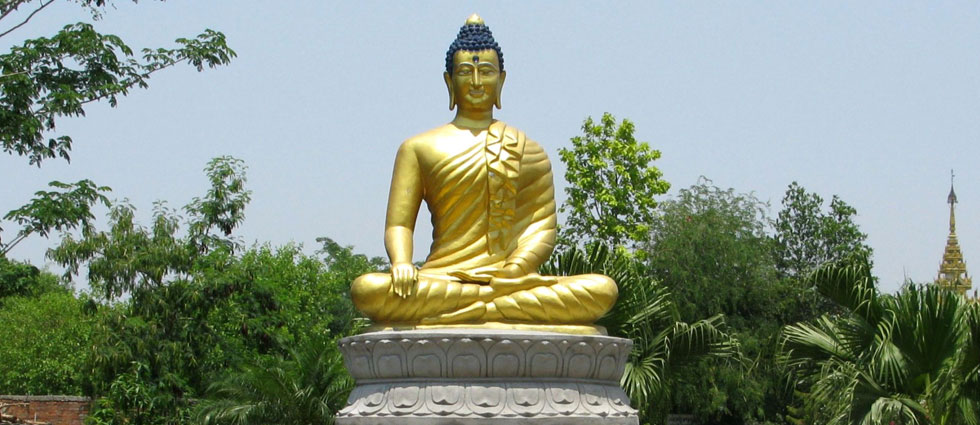
Lumbinī (Nepali and Sanskrit: लुम्बिनी About this sound listen (help·info), "the lovely") is a Buddhist pilgrimage site in the Rupandehi District of Nepal. It is the place where, according to Buddhist tradition, Queen Mayadevi gave birth to Siddhartha Gautama in 563 BCE. Gautama, who achieved Enlightenment some time around 528 BCE, became the Gautama Buddha and founded Buddhism. Lumbini is one of many magnets for pilgrimage that sprang up in places pivotal to the life of Gautama Buddha.

Lumbini has a number of temples, including the Mayadevi Temple and several others which are still under construction. Many monuments, monasteries and a museum — the Lumbini International Research Institute — are also located within the holy site. Also located there is the Puskarini or Holy Pond where the Buddha's mother took the ritual dip prior to his birth and where he, too, had his first bath. At other sites near Lumbini, earlier Buddhas were, according to tradition, born, achieved ultimate Enlightenment and finally relinquished their earthly forms.

Lumbini was granted World Heritage status by UNESCO in 1997.


In the Buddha's time, Lumbini was situated between Kapilavastu and Devadaha (both in Nepal). It was there, that the Buddha was born. A pillar now marks the spot of Ashoka's visit to Lumbini. According to an inscription on the pillar, it was placed there by the people then in charge of the park to commemorate Ashoka's visit and gifts. The park was previously known as Rummindei, two miles (3.2 km) north of Bhagavanpura.


In the Sutta Nipáta (vs. 683) it is stated that the Buddha was born in a village of the Sákyans in the Lumbineyya Janapada. The Buddha stayed in Lumbinívana during his visit to Devadaha and there preached the Devadaha.

Lumbini is a 8-hour drive from Kathmandu and a 30-minute drive from Bhairahawa. The closest airport is Gautam Buddha Airport at Bhairahawa, with flights to and from Kathmandu.

Tilicho Lake


Tilicho Lake is a lake located in the Manang district of Nepal. It is situated at an altitude of 4,919 metres (16,138 ft) in the Annapurna range of the Himalayas. Another source lists the altitude of Lake Tilicho as being 4,949 metres (16,237 ft).

Mountain lakes are known to geographers as tarns if they are caused by glacial activity. Tarns are found mostly in the upper reaches of the Himalaya, above 5,500 metres (18,000 ft).

Tilicho Lake is the destination of one of the most popular side hikes of the Annapurna Circuit trek. The hike takes additional 3–4 days. No camping is required, as new lodges have been built between Manang and the lake. Final approach to the lake is done in a day hike from the lodge at Tilicho Base Camp.

Trekkers attempting the Annapurna Circuit route usually cross the watershed between Manang and Kali Gandaki valleys over the 5416 meters high Thorong La pass. The alternate route skirting Tilicho Lake from the north has been gaining popularity. This route is more demanding and requires at least one night of camping. There are no tea houses or lodges past the Tilicho Base Camp lodge some kilometers east of the lake and the next village of Thini Gaon in the Kali Gandaki valley. Most groups spend two nights between these places. There are two passes leading to Thini Gaon and Jomsom; Mesokanto La and Tilicho North pass known also as Tilicho "Tourist pass". These routes via Tilicho Lake are more often closed by snow than the higher Thorong La.

It was also the site of one of the highest ever altitude scuba dives. A Russian diving team consisting of Andrei Andryushin, Denis Bakin and Maxim Gresko conducted a scuba dive in the lake in 2000.

Surrounding mountains: Tilicho, Nilgiri, Khangsar and Muktinath peak

Mount Everest


Mount Everestalso known in Nepal as Sagarmāthā and in Tibet as Chomolungma, is Earth's highest mountain. It is located in the Mahalangur mountain range in Nepal and Tibet. Its peak is 8,848 metres (29,029 ft) above sea level.[1] The international border between China (Tibet Autonomous Region) and Nepal runs across Everest's precise summit point. Its massif includes neighbouring peaks Lhotse, 8,516 m (27,940 ft); Nuptse, 7,855 m (25,771 ft) and Changtse, 7,580 m (24,870 ft).

In 1856, the Great Trigonometrical Survey of India established the first published height of Everest, then known as Peak XV, at 8,840 m (29,002 ft). The current official height of 8,848 m (29,029 ft) as recognized by China and Nepal was established by a 1955 Indian survey and subsequently confirmed by a Chinese survey in 1975. In 1865, Everest was given its official English name by the Royal Geographical Society upon a recommendation by Andrew Waugh, the British Surveyor General of India. As there appeared to be several different local names, Waugh chose to name the mountain after his predecessor in the post, Sir George Everest, despite George Everest's objections.

Mount Everest attracts many climbers, some of them highly experienced mountaineers. There are two main climbing routes, one approaching the summit from the southeast in Nepal (known as the standard route) and the other from the north in Tibet. While not posing substantial technical climbing challenges on the standard route, Everest presents dangers such as altitude sickness, weather, wind as well as significant objective hazards from avalanches and the Khumbu Ice fall. As of 2016, there are well over 200 corpses still on the mountain, with some of them even serving asland marks.
The first recorded efforts to reach Everest's summit were made by British mountaineers. With Nepal not allowing foreigners into the country at the time, the British made several attempts on the north ridge route from the Tibetan side. After the first reconnaissance expedition by the British in 1921 reached 7,000 m (22,970 ft) on the North Col, the1922 expedition pushed the North ridge route up to 8,320 m (27,300 ft) marking the first time a human had climbed above 8,000 m (26,247 ft). Tragedy struck on the descent from the North col when seven porters were killed in an avalanche. The 1924 expedition resulted in the greatest mystery on Everest to this day: George Mallory and Andrew Irvine made a final summit attempt on June 8 but never returned, sparking debate as to whether they were the first to reach the top. They had been spotted high on the mountain that day but disappeared in the clouds, never to be seen again, until Mallory's body was found in 1999 at 8,155 m (26,755 ft) on the North face. Tenzing Norgay and Edmund Hillary made the first official ascent of Everest in 1953 using the southeast ridge route. Tenzing had reached 8,595 m (28,199 ft) the previous year as a member of the 1952 Swiss expedition. The Chinese mountaineering team of Wang Fuzhou, Gonpo and Qu Yinhua made the first reported ascent of the peak from the North Ridge on May 25, 1960.

statcounter